

Perhaps what makes so many academics truly special is that they refuse to see the world as it really is.
Remember I explained in an article some time ago about the famous early 20th Century propagandist Walter Lippmann. How Lippmann explained that they define and then we see.
The picture that is explained to us, he says, is critical to how we subsequently interpret the world.
It may bear no relationship to anything real — to how the world really is. Lippmann was mostly concerned with war propaganda.
In his lectures on the science of hurricanes, Kerry A. Emanuel goes out of his way to separate out what the textbooks agree fuel hurricanes (water vapour), from what steers and drives hurricanes (the wind). This perhaps serves two purposes for Emanuel:
1. It emphasises his contribution to the field, and
2. It removes water vapour as the key protagonist in the climate change narrative.
For sure, there was no place for Joanne Simpson or her hot towers in Dr Emanuel’s lecture last year; yet we can see them so clearly in the satellite imagery.
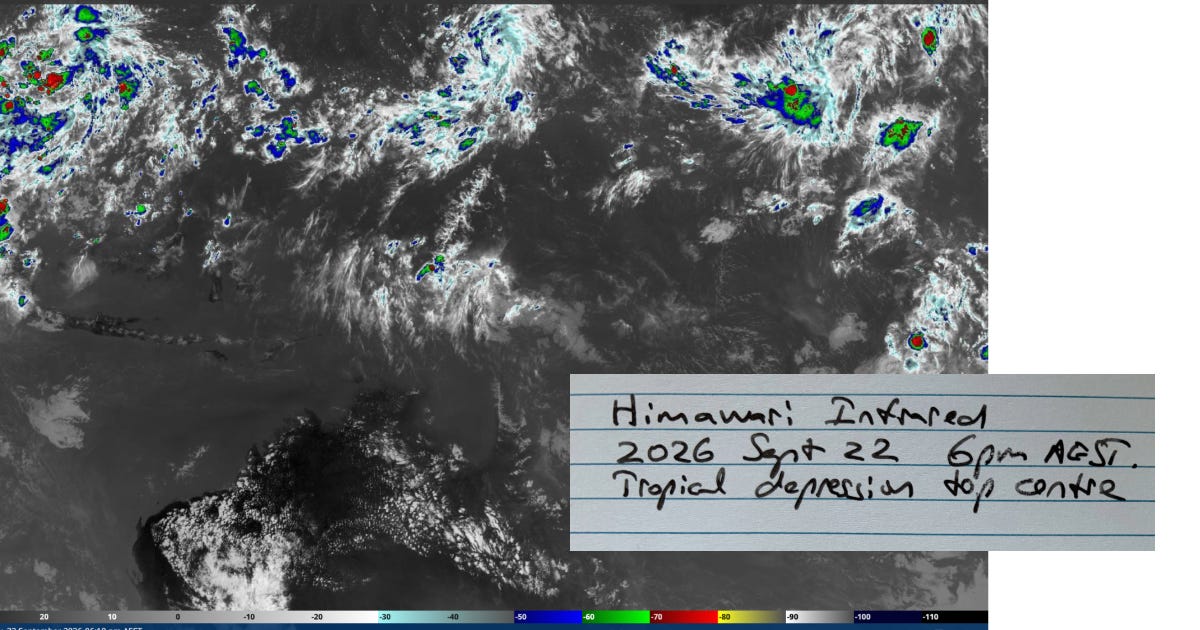
Last week I watched a tropical depression form just to the east south of the Philippines. I took a screen shot on 22ndSeptember, as I sometimes do when I wonder what might become of a particular cloud formation.
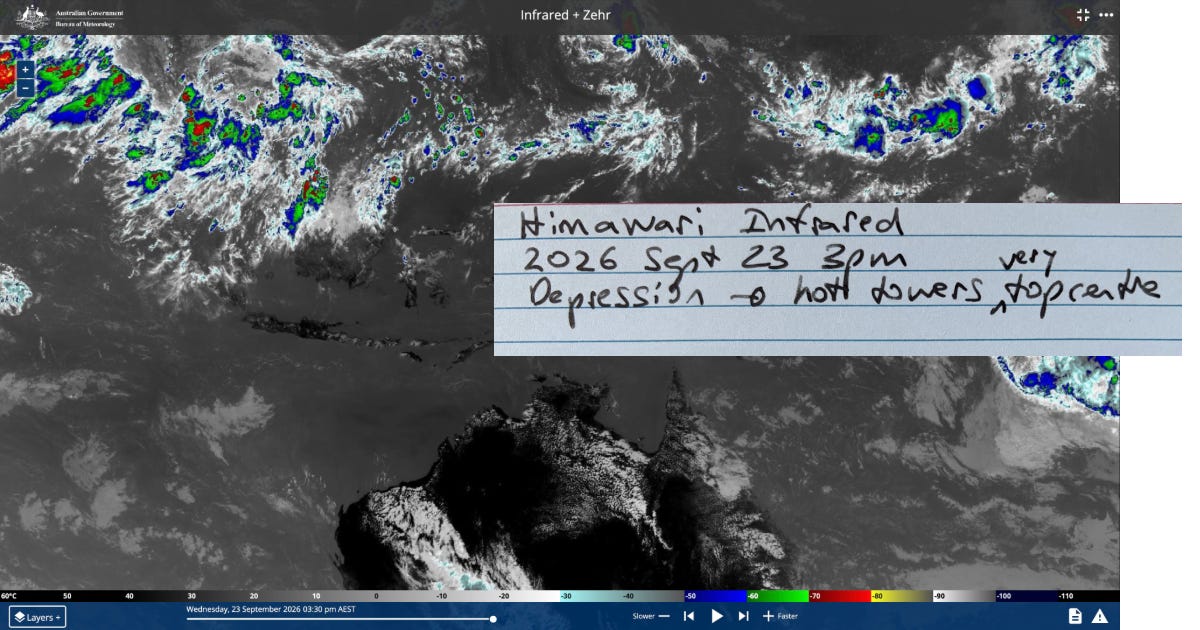
It was due north of Queensland’s Cape York Peninsula. I noticed the cloud band in the loop provided by Japanese’s Himawari-9 satellite to the Australian Bureau of Meteorology.
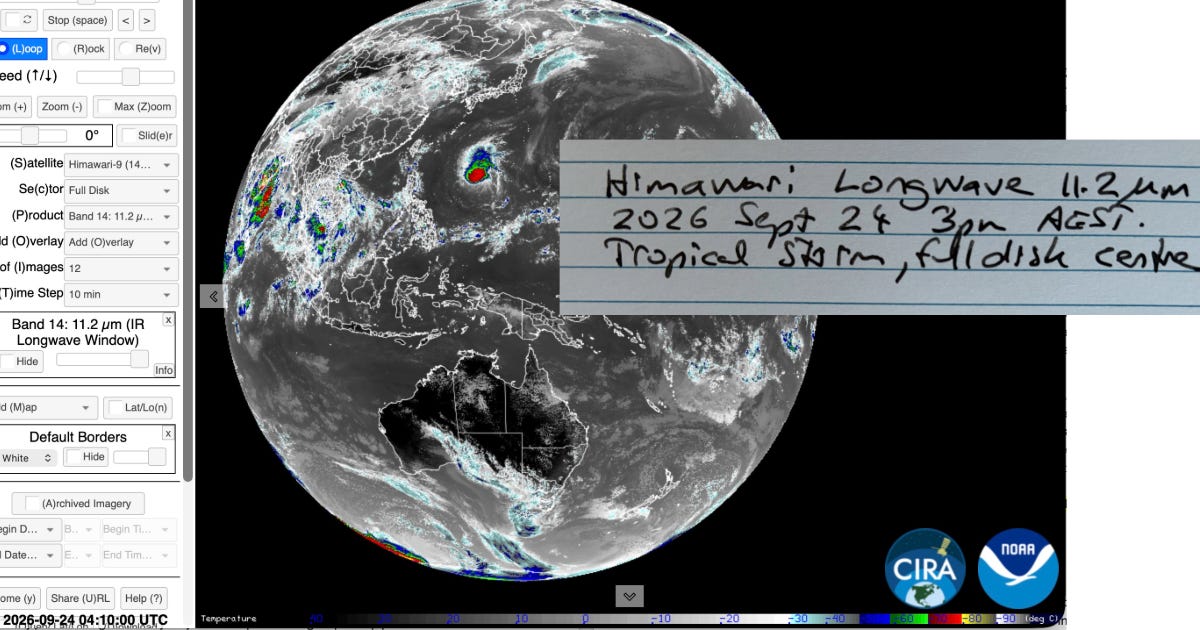
When I went back a day later the tropical depression had formed hot towers and was moving outside the frame provided by Himawari-9 to the BOM, so I switched to the full-disk view at the Colorado State University website the next day. Then I switched to the Asian view, at the mesoscale, to get a close-up of the top of the structure. As I watched the video loop I could see five hot towers punching through the top of the troposphere, at minus 70 degrees Celsius, that was on 24th September.
Then the system was pulled further north, and I watched as it intensified. Today (Sunday, 27th September), it is a recognised tropical cyclone, Typhoon Surigae. The system is due east of Taiwan and heading towards Japan.
As I have repeatedly explained in this SubStack series (beginning with ‘Average doesn’t work in the Tropics’), deep convection — from sunlight that warms the tropical ocean, evaporation that loads the lowest kilometre, condensation that keeps the air rising, until ice spreads at heights of 12 to 16 kms — it punches through the top of the troposphere which would be equivalent to smashing the roof of a greenhouse.
Emanuel manages to contain his hurricanes within the greenhouse picture. He keeps the roof of the greenhouse intact.
Yet in reality, they smash the glass ceiling, as I intend my new #ClimateResilienceTheory to destroy the established narratives with CO2 as the protagonist.
For sure, the idea of the atmosphere as a greenhouse is politically important to the Jokers. It helps fund the Lorenz Centre. The picture is of the Earth’s atmosphere with an intact glass ceiling, mostly impervious to radiation from CO2. The analogy that Dr Emanuel uses at times is of a cold lid, then he will talk about greenhouses gases never once saying water vapour in the same exhale.
He began the 2025 John H. Carlson Lecture suggesting that oil could be substituted for water. If you included wind and a rough surface in the model he claims it is still possible to generate a hurricane. An oil hurricane! On which planet?
A problem for mainstream climate scientists perhaps, is if they wrote about the world as it really is, that would perhaps mean we might understand what they were on about, and then everything could perhaps be reduced to something ordinary, even benign.
I deliberately use the word ‘benign’ because it is a word that Emanuel, who has spent his entire career studying hurricanes, often uses and about the weather in the tropics.
The tropics he says and writes, repeatedly, are mostly ‘benign climates’ with ‘gentle breezes, small daily and seasonal temperature variations.’ He skips from benign to hurricanes and repeatedly asks how something as organised in structure as a hurricane can emerge from apparent chaos.
Of course, he usually ends with a discussion of greenhouse gases and climate change. The lecture he gave last year available on YouTube (link at beginning of this article) being an example of this.
It is, like so much mainstream climate science, a masterclass in obfuscation.
In his discussion of greenhouse gases, he doesn’t separate out water vapour from CO2, but in his discussion of hurricanes he insists that they are not fuelled by water vapour attempting to make an absolute delineation between hot towers and hurricanes. In fact, he never mentions hot towers and suggests if you hear him literally that hurricanes are emergent properties of wind over a rough surface that could even be oil. I repeat myself.
Listening to the lecture was for me, was like going down a rabbit hole with Alice in Wonderland. But I do understand that what he is selling with this lecture, is the mainstream picture. After all, if you listen from the beginning, he is introduced by three other very important people all explaining he is an expert, and very clever. American. Exceptionalism. (Always insisting the world do as they say, as Australia always does as they say, least they confiscate our oil and our gold, as Donald Trump did to Venezuela. I digress.)
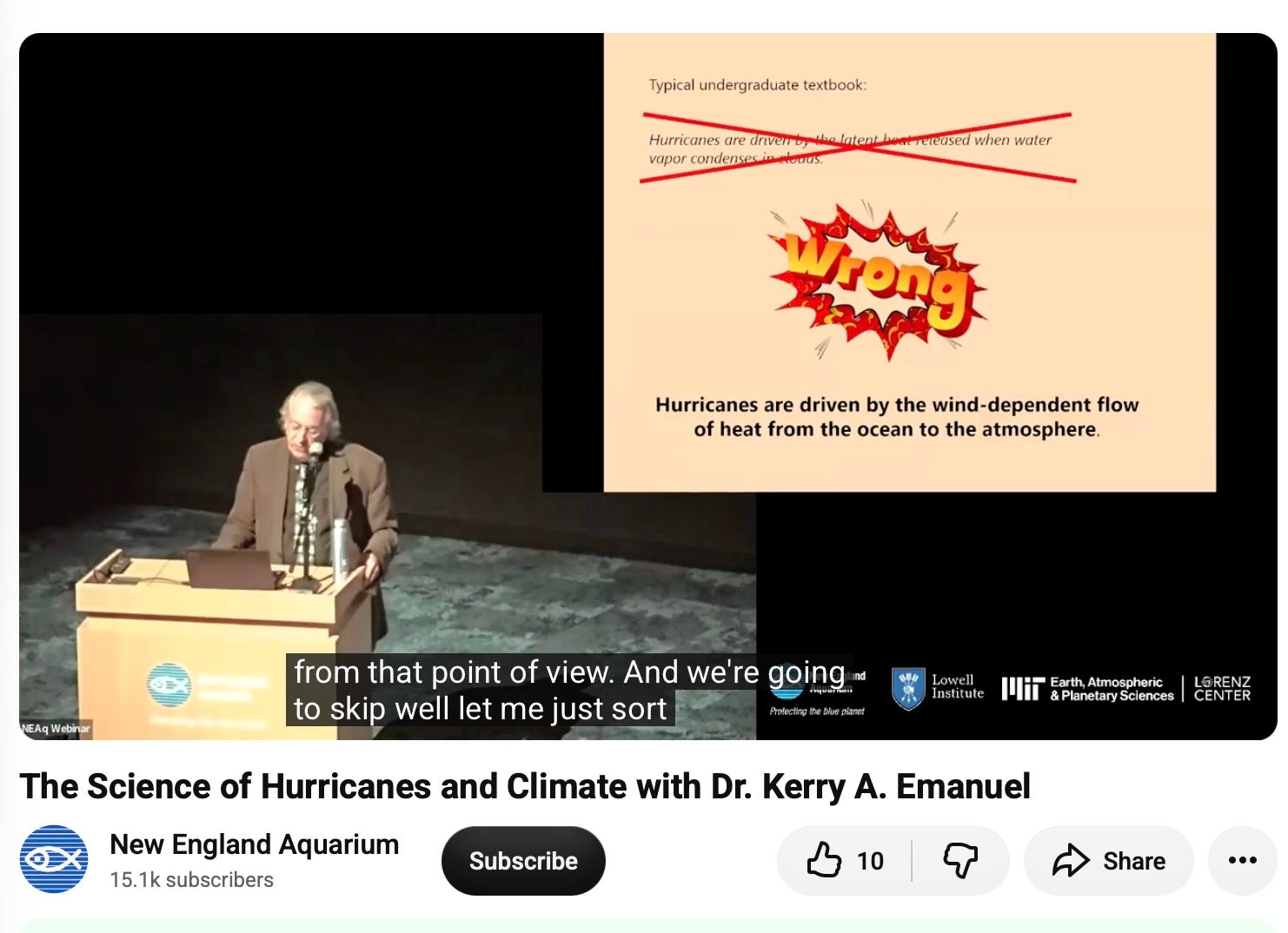
In a key slide, Dr Kerry A. Emanual from MIT in Boston in that lecture available on YouTube, he crosses out ‘hurricanes are driven by the latent heat when water vapour condenses in clouds’ and replaces it with ‘hurricanes are driven by the wind-dependent flow of heat from the ocean to the atmosphere’. As though the two can be separated when they can’t. (You have to first get pregnant, before you can have a baby.)
To be sure, most of the heat that leaves the warm ocean leaves as water vapour that is latent heat, and over a vast area — this latent heat of evaporation is then gathered into the equatorial trough and released when water vapour condenses and later freezes as it goes up the massive hot towers that are kilometres wide.
It is possible to get some idea of this from watching the video loop of Typhoon Surge, the view from the Himawari-9 satellite. If you watch carefully in full screen you can count the hot towers, and watch as they punch through the top of the troposphere. (I can only provide a screenshot here because the video is not downloadable; link in notes at very end of this article.)
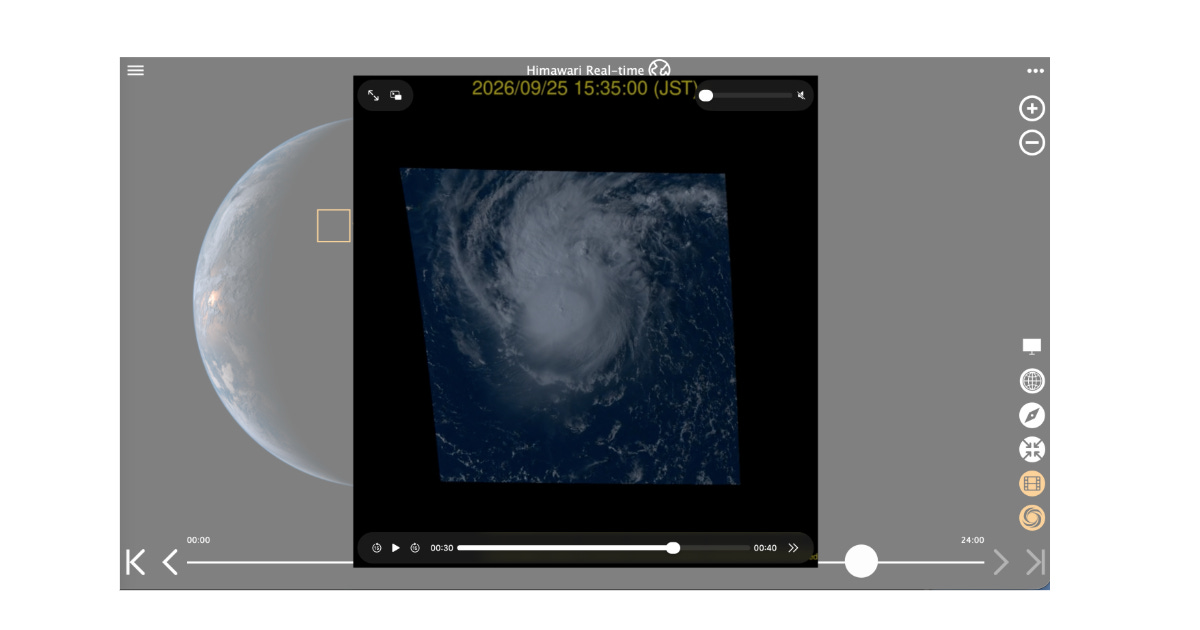
These towers may occupy in the order of only 0.1 percent of the equatorial trough at any given moment yet they carry most all of the upward movement of energy — enough to explain local radiative cooling and leave a surplus for export toward the poles.
This is a very different way of understanding how the weather works. It is Plank 1 of my new #ClimateResilienceTheory.
At any one time between 800 and 1,700 hot towers — think very tall and very intense chimneys within cloud bands with a frozen roof of ice —move energy from the Earth’s surface straight up at least 12 kms beyond the tropopause where this energy will be released when the ice is formed, causing radiation directly to outer space, or moves laterally towards the poles.
These structures are acknowledged by climate scientists as the main pathway for energy movement within the Earth’s atmosphere — they stop the tropical oceans over-heating and limit the extent of freezing at the poles — they are just not included in any of the IPCC models, or included in Emanuel’s narrative at least not in his most recent public YouTube.
Perhaps Emanuel has spent very little time in the tropics, except during that time of year when the monsoon is elsewhere. I can’t image he has ever come up from a scuba dive looked to the horizon and noticed the height of the storm, how quickly it has developed and felt that foreboding. Wondered how long before the thunder and lightning. Then there is the satellite imagery; hasn’t he noticed the deep tropical convection consistently clustered in a band around the equator that is the tropics.
Average Doesn’t Work in the Tropics

The tropics follow a middle line around the Earth, where the Sun beats down with incredible intensity often from a blue-blue sky. It is where I was born and grew-up, feeling the rising tension as the day warmed, and then there might be release often in the late afternoon with a violent thunderstorm.
A tropical cyclone — Emanuel’s hurricane, his shorthand for the generic storm — is what you get when a cluster of those hot towers veers off the equator, picks up enough spin from the Earth’s rotation, and organises around a centre with surface wind continually to feed this emergent and complex structure, as he likes to describe his hurricanes.
His analogy, what he is famous for, is drawing an analogy between hurricanes and heat engines. Energetically his Carnot picture could perhaps run on the equator, but the reality is that mechanically it cannot because the Coriolis is too weak. Using the heat engine analogy, the large vortex will not lock. Only after they gather momentum, which is always after they move away from the equator, only then do they exist for Emanuel.
Perhaps a purist would say I have the physics of work muddled in the above. So let me rephrase: The sea can be warm enough, and the roof cold enough, on the equator. That is not enough. A cyclone is a vortex. Near zero latitude there is not enough Coriolis to lock one. You can have the hot towers with their chimneys. You cannot have his spinning engine, or a tropical cyclone.
As I have already detailed, last week I watched a tropical depression form just to the east of the Philippines, within a day I could see hot towers as they moved outside the frame provided to the Australian Bureau of Meteorology, perhaps a cluster of five punching through. Then the system was pulled north. Now it is called Typhoon Surigae, and it is expected to intensify into a tropical cyclone that could make landfall over Japan.
There was an evolution. It is my observation:
The warm sea loads the water vapour. Without that there is no fuel for either hot towers or hurricanes.
If that air is lifted and very moist, condensation is not optional. Pressure falls with height; the vapour cannot remain vapour. Latent heat is released in the column. That is why a tower can grow in an afternoon over warm water. I’ve watched this, from Darwin harbour and in the coral sea from boats.
If the core stays undiluted — little mixing at the edges — the shaft can reach the top of the troposphere and ice over. That is the chimney that smashes through.
If the cluster is steered off the trough intact, Coriolis can turn it into a vortex with an eye. Near the equator you can have the hot towers and no cyclone.
Wind-dependent flux from a rough sea is the piece Emanuel spent a career quantifying. It is how an already spinning storm intensifies.
Shear, dry air, and a cold wake in the ocean are brakes on that vortex. They matter less to a single hot tower that often lives and dies in an afternoon, as a thunderstorm. Many towers are solitary. Some towers coalesce. Very few towers organise into hurricanes that are tropical cyclones, but it does happen.
If I can add a paragraph that I received from retired NASA Aerospace Engineer (and a dear friend) Alex Pope. He says much of this in different words that may be useful. I concur mostly, not entirely.
Importantly, Alex Pope ends with mention of CO2, and he has a different perspective. He emailed me:
Energy from evaporating water at the surface, carried by convection to high altitude, created the towers.
The warm energy in the water at the surface was used to form the water vapor, which released the energy difference of water-to-water vapor, a huge amount.
As the water vapor is carried up to high altitude by convection, some water vapor becomes water, releasing large amounts of energy, much of that is radiated out, some of the water becomes ice, releasing large amounts of energy, much of that is radiated out, some water vapor becomes ice, releasing energy equal to the sum of the other two conversions.
The energy radiated out from the sum of these changes of states is massive, cooling the climate system.
Once there is ice at the top of all this, most of the energy gained from the evaporation at the surface, change of state at the surface, is already radiated out due to changes of state to water and ice, the ice can get some colder, radiating some more energy out but the IR out from the ice it is not significant compared to the energy out from changes of states to become ice.
All the clouds and all the ice are significant in promoting albedo. That ice at high altitude, topping the other clouds, is not changing state, it is not changing temperature, it is not radiating significant energy out, but it is reflecting incoming solar radiation.
Radiation from CO2, for warming or cooling, cannot be significant because it does not have much mass and it is not changing states, CO2 is supposed to catch outgoing radiation and radiate it back down, but CO2 is orders of magnitude less mass than water in its changing states and the CO2 is not changing states, the influence of CO2 is much closer to nothing than it is close to anything measurable and verifiable.
Water’s phase changes dwarf carbon dioxide by mass. That is why the hot towers and the ice roof do the vertical work. It is not a proof that CO2 cannot absorb infrared. Those are different things.
The order is not optional:
Warm sea.
Hot towers — undiluted, ice roofs.
A shove off the equator so the cluster can rotate.
Then, and only then, wind-dependent flux from a rough sea, an eye, a named tropical cyclone — Emanuel likes to call them all hurricanes.
It is only at 4. that Dr Kerry A. Emanuel begins the official hurricane story. For sure, he is the consensus and the expert. That doesn't mean he has an accurate or useful representation of reality, certainly not in his 2025 public lecture at YouTube.
Satellite imagery here:
https://www.bom.gov.au/australia/satellite/
https://rammb-slider.cira.colostate.edu/
oh.. I agree and understood your points. I merely meant to add to the point regarding strength of these systems. Movement of mass across our thin 1atm atmosphere, Hadley Cells, Ferrel Cells, Rosby waves, SAM, PDO, ENSO, AMO, IOD, etc. and the opposing seasons between NH and SH are key. Many don't say much about the power of the unbroken SH polar vortex, due to there being nothing but ocean surrounding it ( no land or mountains to disrupt like NH pole which often splits into two) and 70% SH surface area being water. The tighteness of the SH vortex and the resulting chemistry from NOx and Ozone chemistry is profound, and the lapse rate defined temperatures that elvolve from the pressures movement of mass extend all the way back to the equator and back into the NH. https://earth.nullschool.net/ is a handy tool. ..oops. gone off a bit...sorry.
you mention coreolis effect. if I could post an image, I’d prove no cyclones or hurricanes cross the equatorial line.